
In 2012, the Royal Canadian Mint terminated the production of one-cent coins, establishing the final mintage for this denominational unit.
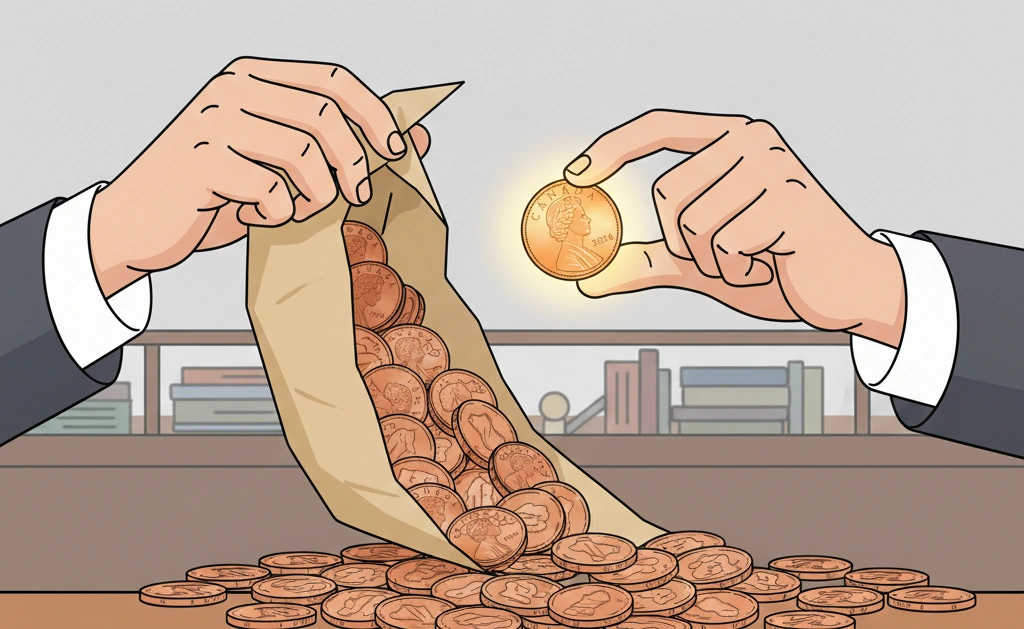
Despite the massive withdrawal of coins from circulation, a significant number of valuable specimens remains in private holdings.
The numismatic value of these objects is determined not by the issue date, but by the presence of rare technological anomalies or specific changes in die designs.
Identifying valuable Canadian Pennies requires accounting for physical parameters changing over the decades.
Production Period | Base Metal | Weight | Diameter |
1920 – 1977 | Copper (98%) | 3.24 | 19.05 |
1982 – 1996 | Copper (98%) | 2.50 | 19.05 |
1997 – 1999 | Copper-plated zinc | 2.25 | 19.05 |
2000 – 2012 | Copper-plated steel | 2.25 | 19.05 |
A weight deviation exceeding 0.15 grams often serves as an indicator of striking on a non-standard planchet, automatically increasing the coin value.
1953–1955 Issues
At the beginning of Queen Elizabeth II's reign, the obverse design contained a technical defect leading to rapid wear of working tools.
"No Shoulder Fold" (NSF) Variety
This type is characterized by the absence of a pronounced fold on the shoulder of the coronation gown.
In 1953, this variant was common, yet in 1955, it became extremely rare.
Cost of a 1955 NSF in MS63 condition: $300 - $500.
Cost of a 1955 NSF in MS65 Red condition: exceeding $1,500.
For comparison, the standard 1955 variant in a similar condition is valued at less than 10 dollars.
The 2006 Issue Problem
In 2006, the mint utilized three different types of planchets, creating a complex rarity gradation system.
Zinc coins without a mark or logo. Non-magnetic, weighing 2.25 g.
Steel coins with a logo (P). Magnetic, weighing 2.35 g.
Steel coins without a logo. Magnetic, representing an extremely rare anomaly.
The rare 2006 variant lacking the "P" mark and logo while possessing magnetic properties is valued in the range of 200 to 500 dollars for a certified specimen.
Auction Record
The market for rare Canadian pennies demonstrates resilience supported by the official cessation of minting.
1936 Dot Cent
This coin serves as the benchmark of rarity in Canadian numismatics.
In 2010, a specimen was sold for 402,500 US dollars.
Statistics from the last 15 years show an average annual value growth of 3-5% for museum-level coins despite rare periods of stagnation during the resale of identical lots.
1920s Issues
The 1922, 1923, and 1925 coins feature minimal mintage figures.
Year | Mintage (thousand units) | Record Price (MS65 Red) | Annual Value Growth |
1922 | 1,243 | $12,000 | 4.8% |
1923 | 1,019 | $16,500 | 5.2% |
1925 | 1,000 | $14,000 | 4.5% |
Price dynamics for these positions over the last 20 years confirm the status of these coins as stable assets protected from inflationary risks.
Classification and Value
Production defects often mistaken for damage represent a significant interest when identified correctly with the free coin identifier.
Die Rotations
A die rotation of 180 degrees relative to the obverse turns an ordinary cent into a rare collectible object.
90-degree rotation: $50 - $120.
180-degree rotation: $400 - $900.
Off-center Strikes
Displacement of the planchet at the moment of impact leads to the appearance of an un-struck field.
25% displacement: $40 - $100.
50% displacement with a visible date: $250 - $600.
Wrong Planchet Errors
The rarest type of error involves using planchets intended for 10 or 25 cents.
A penny struck on a dime planchet (silvery color, weighing 1.75 g) can reach a price of 2,000 dollars at specialized trades.
Probability of Discovering Rare Specimens
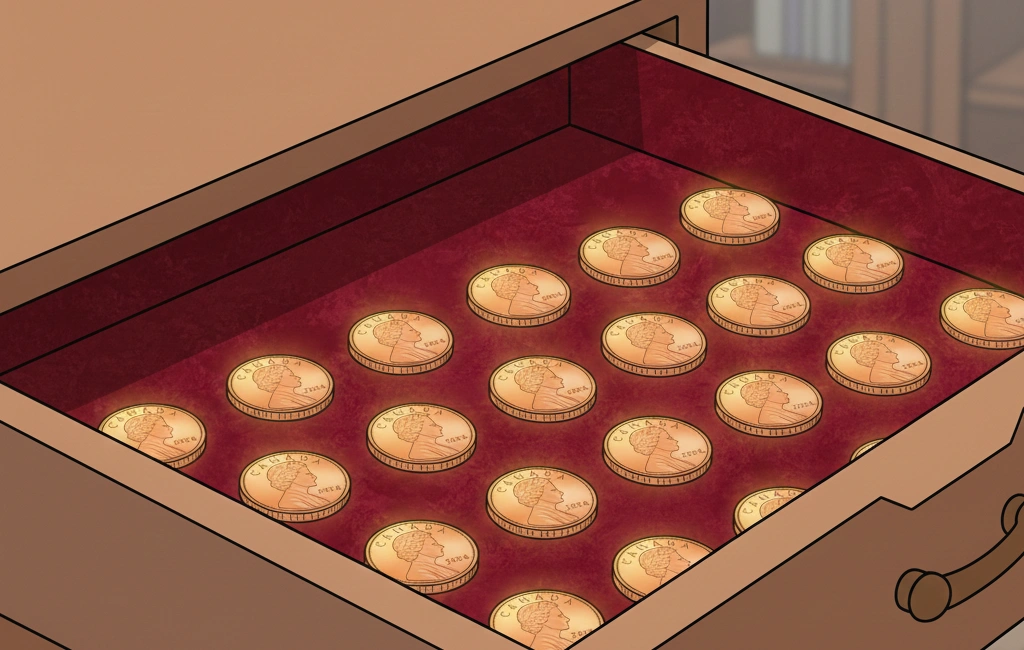
According to data from numismatic societies, the distribution density of rare varieties in the total coin mass is extremely uneven.
Statistical probability model:
Probability of finding 1923 in a random lot: less than 0.001%.
Probability of detecting 1955 NSF: 0.02%.
Probability of finding minor Die Cracks: 1.5%.
A high concentration of valuable coins is observed in old domestic piggy banks formed before the 2000s.
Evaluation Methodology
The international Sheldon scale is applied to confirm market value.
Key factors influencing price:
Surface Color (RD, RB, BN). Fully Red (RD) coins cost 300-500% more than Brown (BN) counterparts of the same year.
Absence of Corrosion. Zinc and steel in coin compositions after 1996 deteriorate rapidly under moisture, making ideal specimens extremely rare.
Striking Sharpness. The presence of fine details, such as dress folds or veins on the maple leaf, determines the final grade.
Certification on Market Liquidity
Selling coins valued above 100 dollars without an ICCS or PCGS certificate involves financial losses.
Certified coins sell on average 40% faster and for more than uncertified lots.
The annual increase in the number of certified top-grade specimens (MS66+) is slowing down, provoking price growth for existing positions in registries.
Self-Identification Protocol
Following a technical algorithm is recommended for identifying valuable objects:
Sorting by Dates. Separating pre-1930 issues and key dates (1947, 1953-1955, 2006).
Magnetic Tool Verification. Identifying rare steel anomalies among mid-2000s issues.
Weighing. Using electronic scales to search for coins on light or heavy planchets.
Coin Appraisal App. Searching for the 1936 dot or NSF signs in Elizabeth II issues.
Conclusion
Issues from the 1950s and modern magnetic errors, often overlooked by non-professionals, remain the most promising for search.
The Canadian copper market demonstrates a stable yield of 5.5% per annum for mid-price range assets ($500 - $2,000).
A systematic approach to studying existing material allows for significantly increasing the estimated value of a numismatic portfolio without additional financial investments.
Continuing cataloging and studying minor mintage deviations remain the primary tools of a modern collector.